One of my favorite sections in The Together Teammate is around Closing Loops. Closing Loops is important for to-dos to be closed to finality, to ensure others know the status of tasks, and to avoid duplicate work.
I was thinking about this in the context of Ticketmaster. Stay with me here, but sometime in early 2025, I got into the pre-sale Ticketmaster waiting room and excitedly purchased three tickets to see comedian John Mulaney in December of 2025–for Dr. Together, Together Tech Exec, and myself. For some inane reason, I have two separate Ticketmaster accounts (and I also have StubHub and SeatGeek accounts!), which inevitably leads to a whole kerfuffle: Where did I put the tickets? Did a third party send them to me in yet another app? Did I save them to Apple Wallet? Had I shared them with Dr. Together? And so on. After several previous occasions of hunting frantically for tickets before an event, I vowed to Close the Loop like never before.
Upon purchase of the tickets, I immediately entered the show date into our family Google calendar (per usual), BUT I took it one step further to Close the Loop WITH A BOW.
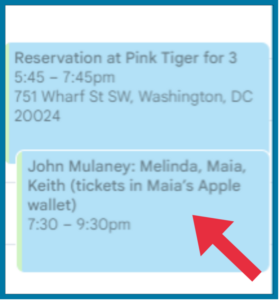
Check out that second appointment and the parenthetical “Tickets in Maia’s Apple Wallet.” Because these are tickets that happened to land upon purchase, I added to my calendar where I had put them – no last-minute frantic hunting for me that week!
So, this got me thinking about how we can all Close the Loops Tightly in work and life – to take the extra step to release the mental load because the bow is tied tightly. This is a powerful step in your own system (like my Ticketmaster story) but becomes a super-power when working with others. A few examples came to mind:
- When you send an inquiry or request to someone, do you have a system to follow-up if it is not returned? Just because you request it of someone else, you are still responsible for Closing the Loop. Some people cc: themselves, set task or calendar reminders, or have a delayed send ready to go.
- When you are handling a task, do you include a step to update the other parties as needed? I know when I assign a task, it lives somewhere in the back of my brain and takes some mental load. But if there is a regular agenda item to receive a status update, that ensures the Closed Loop.
- When you promise someone an update—even if the answer is “nothing changed” —do you actually send it? For example, if you tell your boss, “I’ll circle back once I hear from Legal,” the loop isn’t closed when Legal responds; it’s closed when you proactively follow up and say, “I heard back from Legal—no issues, moving forward as planned,” or “Still waiting, next check-in is Friday.”
- When things change, do you close a loop before opening a new one? What I mean by this is saying aloud, “Path A is officially closed as we have decided it is not viable. Let’s pursue Plan B.” Sometimes ideas can linger that others thought would be pursued, so we must take the time to formally communicate the shift in plans.
To me, Closing the Loop is not about being rigid. It is taking the extra step to define clarity, ownership, and finality – helping us all reduce the mental load of wondering, hunting, or waiting.