Together Friends,
One of my favorite things about writing these Together Tours is getting to peek inside the very real systems people build for very real lives.
Sometimes those systems are highly polished. Sometimes they’re beautifully scrappy. And often – as is the case with this month’s guest – they evolve over time alongside changing roles, roommates, relationships, and responsibilities. Let’s meet Susie Smith, who joined us for one of our Together Leader classes in the winter of 2025. We fell in love with her commitment to her paper planner coupled with her digital life.
Together Tour: Susie Smith
Susie started teaching in 2019 (which means, yes, her first years in the classroom included teaching seventh grade math virtually during the pandemic). After several years at various schools in Massachusetts, Susie has embarked on a hybrid entrepreneurial life. She is a consultant offering instructional coaching, professional development, and curriculum development to a variety of organizations (and open to more!).
Through it all, she’s developed a deeply practical system built around her Passion Planner, Google Calendar, shared household systems, and a strong understanding of her own energy and workflow. Let’s take a look.

Let’s talk about your Passion Planner. What makes it work so well for you?
My love of planners goes way back. The last time I consistently used a paper planner before this was in college when I was chief of staff for student government. I was juggling a million things – budgets, meetings, working with the mayor’s office – and I needed a system.
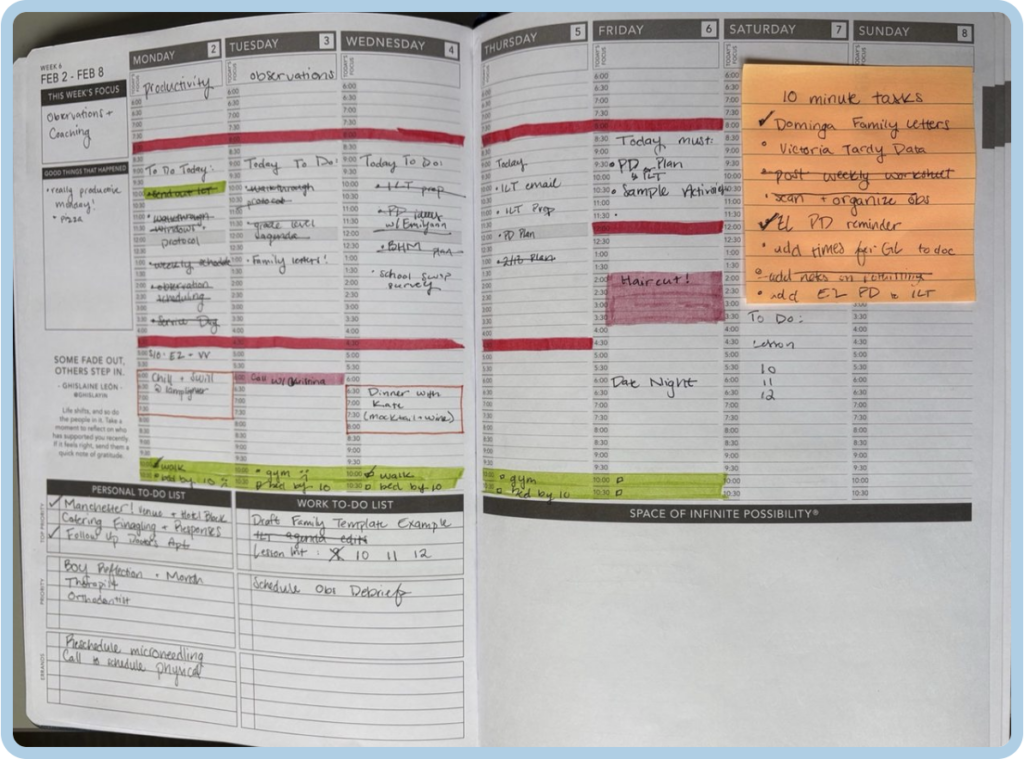
I’ve always liked planners, but for a while I felt weirdly guilty about liking “pretty planners.” I tend to absolutely destroy my planner by the end of the year because I use it so heavily. What works for me now is that my planner and my Google Calendar serve two completely different purposes.
Tell us more about how your planner and Google Calendar work together.
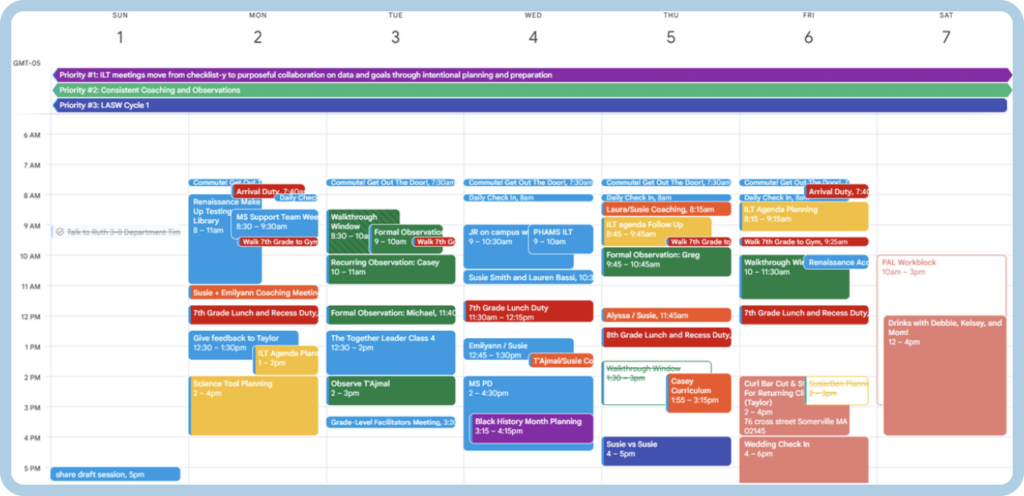
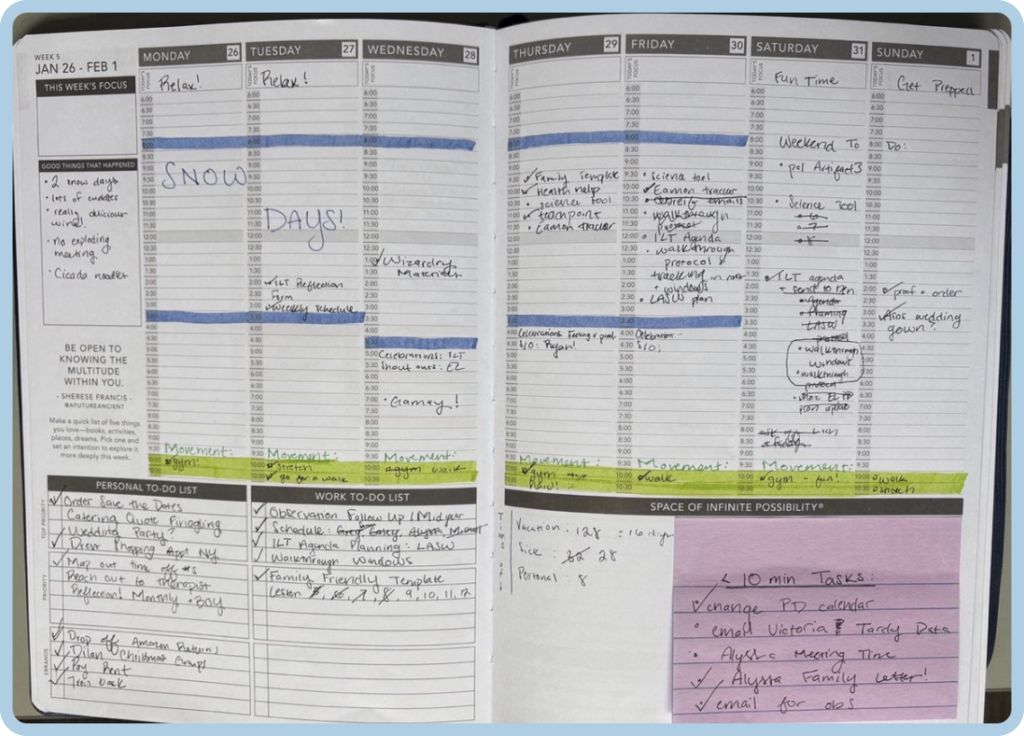
My Google Calendar is entirely about time. Anything happening at a specific time – meetings, classes, appointments, gym classes – goes there.
My planner is about workflow and tasks. Each morning, or sometimes before I leave work the day before, I build my daily To-Do list directly into the planner. Smaller action items live inside the day blocks, while bigger projects live in the larger “work To-Do list” section at the bottom. So something like “double check MCAS accommodations” might go into a specific day, while a larger fellowship presentation would live in the weekly task area until I’m ready to work on it.
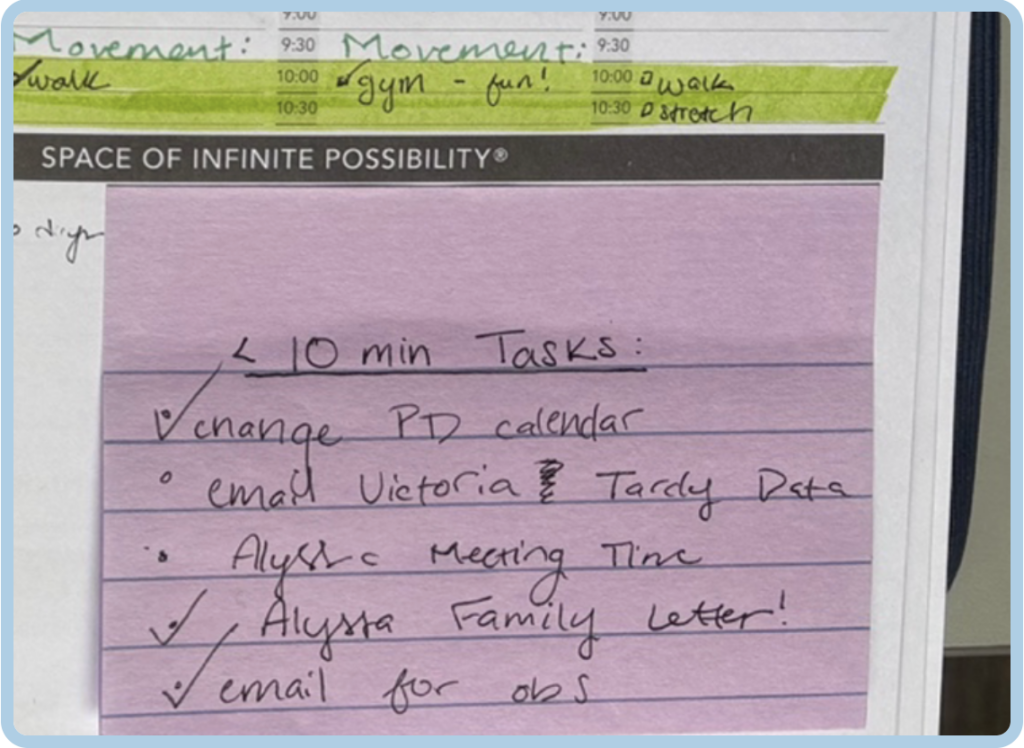
I use the 10-minute Post-It as a catch-all for things that don’t “deserve” a spot in my daily To-Do list or larger project planner. These are frequently the things that I think about doing, in the middle of doing something else. For example, when I was Assistant Principal at Prospect Hills Academy and was in a meeting, if an item popped into my head or was mentioned during the meeting that needed to be done and could be done quickly, I would write it there. These are frequently emails to send, questions to ask people, or documents that need to be updated.
You mentioned that you think a lot about matching your work to your energy. What does that mean for you?
I naturally think in terms of time and energy together. When I look at my To-Do list, I’m not just asking, “What needs to get done?” I’m also asking, “What kind of energy do I have right now?”
Some tasks require deep focus. Some are easier admin tasks. Some things fit better in the evening or on weekends. I’ve learned that I work much better when I’m realistic about that instead of forcing myself into a rigid system. (Editor’s Note: We just wrote about this in our most recent newsletter!)
Your planner pages are very “lived in,” which I personally love. How do you think about consistency versus perfection?
I definitely ebb and flow with how consistently I use it. There are weeks where everything is beautifully organized, and there are weeks where I’m clearly catching up after snow days or vacation. But honestly? When I’m using it consistently, my life is better. And I think that matters more than perfection.
You also shared your monthly reflection pages. What role does reflection play in your systems?
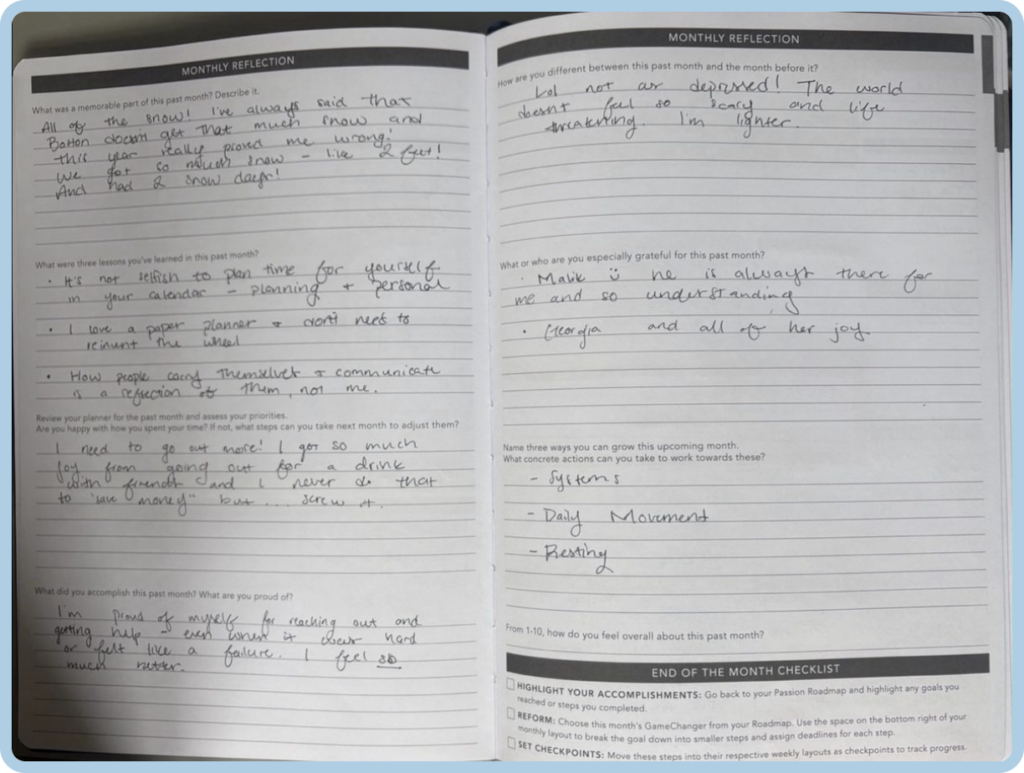
Reflection is something I’m actively trying to get better at. I would love to be someone who journals every day… but I’m just not. So I’ve tried to build reflection into my planner in a way that feels manageable. If I complete the monthly reflection pages consistently, I count that as a win. It helps me pause and notice patterns instead of just constantly moving forward.
You also live in a very collaborative household. How do you all stay coordinated?
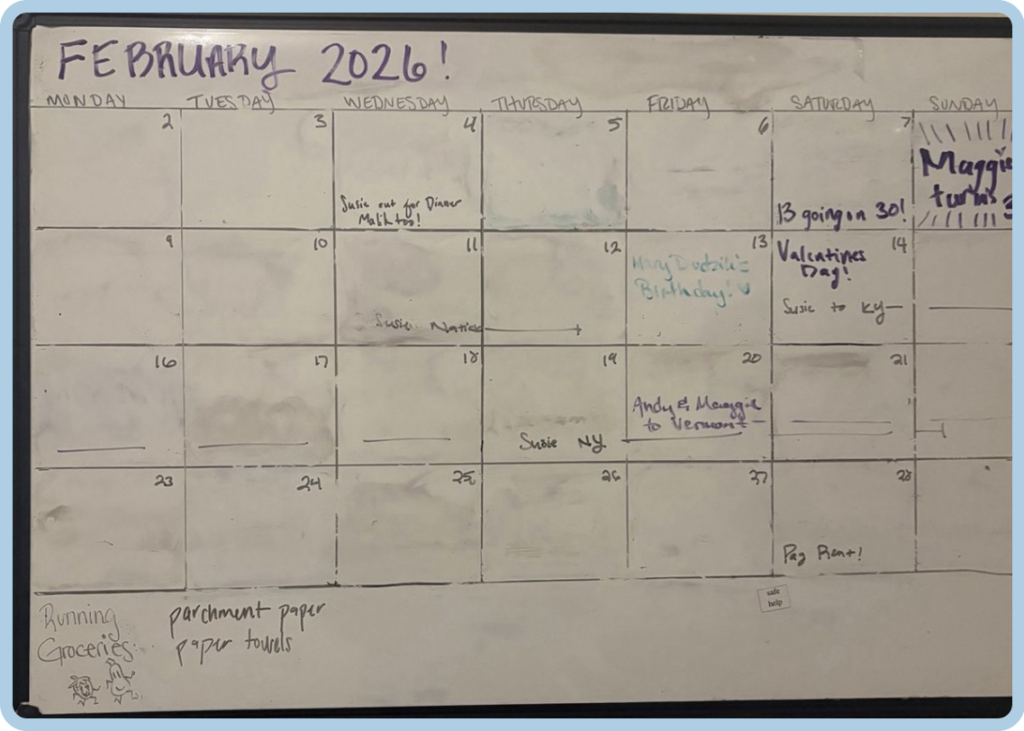
I’ve basically always lived with roommates since college. Right now, we have a shared whiteboard calendar in the kitchen for the four of us. We track travel, performances, races, visitors – all the big household logistics. One roommate’s partner is in a band, another is a runner doing races all the time, and we’re all coordinating schedules, groceries, and dinners together.
My roommates and I share responsibility for cooking. We use our group chat to claim who is making dinner that evening, and refer to the calendar in the kitchen to determine who will be present, how much to cook, and what time dinner should be so it is hot when everyone gets home. We cook for each other constantly. I usually handle the Sunday grocery run and make a more elaborate Sunday dinner for everyone. It’s honestly one of my favorite parts of our house culture.
Since our first interview, your employment situation has shifted. How have you adjusted your Togetherness since then?
My scheduling and Togethering looks VERY different now than it did in the past because my schedule and calendar are much more variable and I have to keep track of so much more. Now that I don’t have the same building blocks and guidelines (like school hours and repeated tasks) for my schedule, I’ve had to be more on top of setting boundaries and creating workflows for myself, which is hard.
When these changes first started, I strayed from my systems, and I felt disorganized and lost in all the “freedom” I had gained. Now I’m setting more schedules and routines for myself so that my days can still have a flow, and I’m moving myself back towards the tried-and-true systems (I’m sorry I ever forgot you, Passion Planner). Because of that my brain and my life are starting to feel calmer. Juggling four jobs requires all of my organizational skills!
It’s been an absolutely wild few months with job searching, apartment hunting, wedding planning then getting married and working full-time! I’m glad to be settling into this new life and my new versions of the same systems. Even though we don’t have roommates anymore, my husband and I are still using a shared calendar to track nights that I’m traveling or working and he’s racing! Don’t fix something that isn’t broken!
What’s one Togetherness lesson you feel like you’re still learning?
That systems don’t have to be perfect to work. I’m still figuring out how to better block time for things outside work – especially fellowship work or personal goals – instead of just hoping I’ll “fit them in.”
But I’ve learned that having some structure is always better than none. And I’ve also learned that flexibility matters. My systems have to work with my actual life – not some imaginary version of it.
Susie, thank you for sharing such a thoughtful and honest look inside your systems. I especially loved seeing how intentionally you separate time from tasks – and how your systems flex to support not just your work, but your relationships, your household, and your future plans as well.
And as someone who also appreciates a very “well-loved” planner, I firmly believe that a planner that looks destroyed is a planner that has fully served its function.

- How do you stay Together when you travel? As you may have heard, I’ve had a busy summer of travel this year. These Together Traveler upgrades help me stay on top of everything so I can focus on teaching. Now, if I wasn’t such a maximalist overpacker, I wouldn’t need little containers, but I am who I am.
- Support your students’ Togetherness. I spend a lot of my time working with adults, but I also love the idea of a Together Student. If you feel the same, check out these suggestions to help young people on their Togetherness journeys. We have also written about this here, here, and here. And this fall, I begin research for. . .Together For College. I’m curious to see where this goes!
- Embrace the September calendar reset. For many of us, September feels like we’re starting from scratch, especially after a busy summer. Reset the calendar and adjust your priorities for this season of the year! And, if you need some support looking ahead to 2027 (gulp, gasp, hiss, curse, but I did order my holiday card stamps already because chipmunks in snow were going to sell out!), come join us for a Together Community Pop Up. . .